
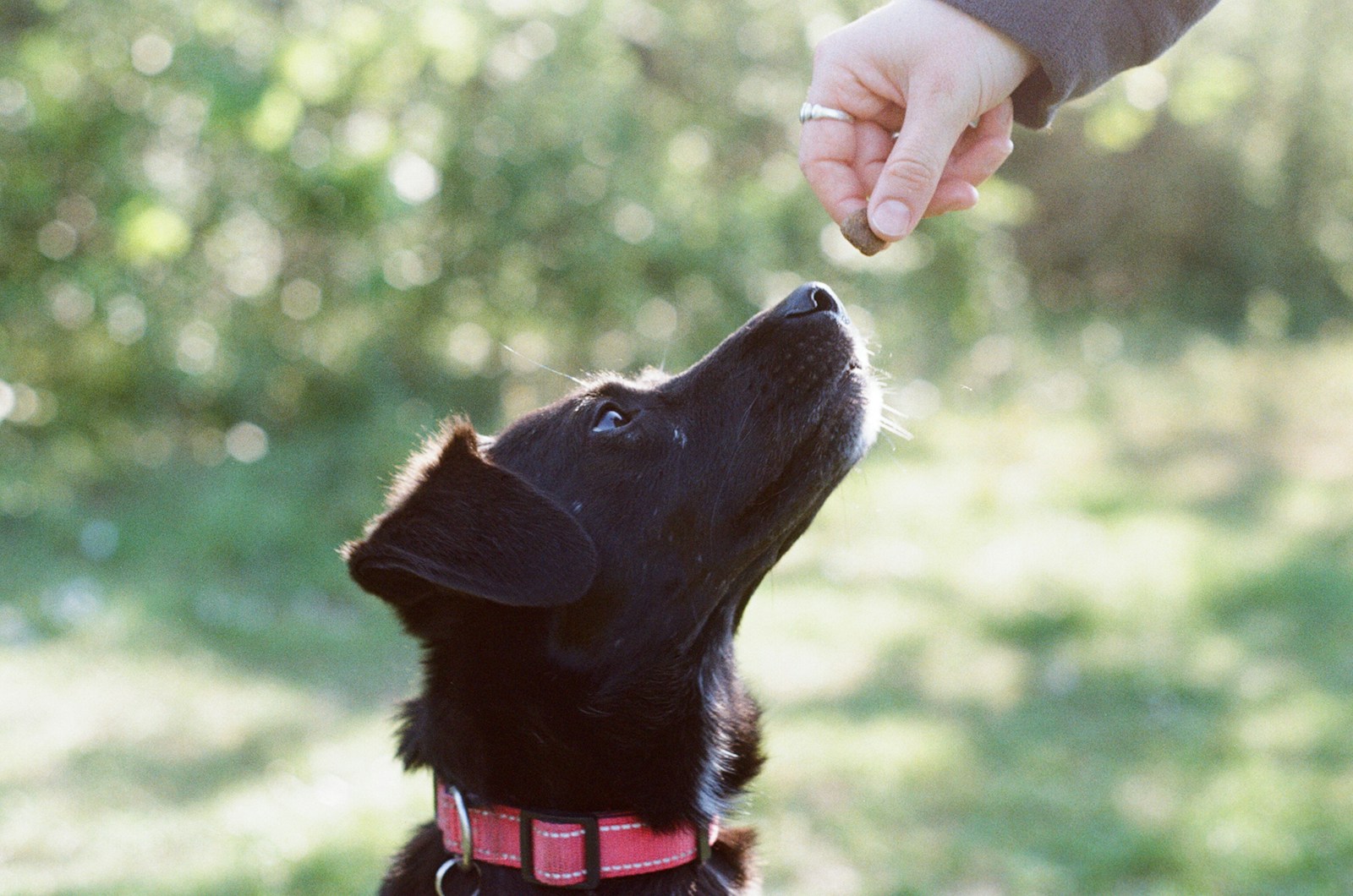
Your dog sits perfectly when there’s a treat in your hand. They come when called, follow commands, and seem completely focused on you. Put the food away, however, and suddenly they’re not quite so interested.
If your dog only listens when treats are involved, you’re not alone. Food is a powerful motivator for many dogs, which is one reason it’s commonly used during training. However, there’s a difference between using food to teach a behavior and accidentally teaching your dog that they only need to respond when they can see a reward.
This doesn’t necessarily mean your dog is stubborn or that you’ve trained them incorrectly. There may be something about their learning, motivation, or training environment that needs more attention.
Let’s look at why this happens, how to recognize the problem, and what you can do to build more reliable responses.
How Do Dogs Learn Through Food Rewards?
Dogs learn partly through the consequences of their behavior. When an action leads to something they enjoy, they’re more likely to repeat it in similar circumstances. This process is known as positive reinforcement.
For example, if you ask your dog to sit and give them a treat immediately afterward, the food can reinforce the behavior. With consistent training, your dog begins to understand that responding to the command can lead to something rewarding.
Food is particularly useful because many dogs find it motivating, it’s easy to deliver, and it allows you to reinforce a behavior at a precise moment. However, the timing and presentation of the reward matter.
If you consistently show your dog food before giving a command, the visible treat may become part of the cue they’ve learned to recognize. Instead of responding to your verbal instruction alone, they may begin to expect food to be present before performing the behavior.
This is why it’s important to distinguish between a dog that expects a reward after responding and one that only responds when the reward is already visible. The first isn’t necessarily a problem. The second may indicate that the way you’ve been using food needs adjusting.
Does Your Dog Understand the Command, or Just Recognize the Treat?
Before deciding your dog is ignoring you, consider whether they’ve learned to respond to the command independently.
A dog might sit immediately when you hold food above their head but hesitate when you give the same instruction with empty hands. Another might respond perfectly in the living room but struggle when you ask them to sit outside.
These situations can look similar, but they may have different explanations.
What you notice vs what it could mean:
- Your dog only responds when food is visible = The treat may have become part of the learned cue
- Your dog listens at home but not outside = They may not have learned to respond reliably around distractions
- Your dog responds inconsistently everywhere = The command may not be fully established
- Your dog responds without seeing food but expects a reward afterward = This can be a normal part of reward-based learning
These aren’t definitive diagnoses, but they can help you identify where your training may need work.
Try observing your dog with a familiar command in a quiet, comfortable environment. Do they respond to your verbal cue without seeing food? Do they need an additional hand gesture? Does their response change when you move to another room?
If they struggle, don’t turn it into a battle or repeatedly test them. Return to an easier stage of training where you can help them understand what you’re asking.
Are You Rewarding Your Dog or Bribing Them?
The words reward and bribe are often used interchangeably in dog training, but there’s an important practical distinction.
Luring involves using something desirable, often food, to guide a dog into a behavior. For example, moving a treat above a dog’s nose may encourage them to sit. This can be useful when introducing a new command, although the food lure should eventually be separated from the cue you’re teaching.
Rewarding means providing something the dog values after a behavior. If your dog sits when asked and receives a treat afterward, that food may reinforce their response.
Bribing, in everyday training language, describes a situation where you repeatedly need to show your dog something desirable to persuade them to perform a behavior they already understand.
Imagine asking your dog to sit. They ignore you, so you take out a treat and repeat the command. Your dog immediately sits. If this becomes your usual routine, your dog may learn that waiting for food to appear is part of the process.
This doesn’t mean showing a treat is always bribery, or that rewarding your dog frequently is wrong. The important question is whether your dog understands and responds to the cue itself, or whether visible food has become a condition of cooperation.
Why Your Dog Might Ignore You Even When They Know the Command
Treat dependency isn’t the only reason dogs respond inconsistently. Sometimes a dog understands a command in one situation but struggles to perform it somewhere else.
Distractions and Competing Motivations
Imagine calling your dog while they’re investigating an interesting smell or playing with another dog. Returning to you means leaving something they currently enjoy.
Even if they understand the recall command, the surrounding environment may be more motivating than what you’re offering.
This is why practicing commands only at home isn’t enough. Dogs need opportunities to learn how to respond in different environments, with distractions introduced at an appropriate level.
Inconsistent Communication
Your response to your dog’s behavior can also influence what they learn.
If you regularly repeat a command several times before getting a response, your dog may become accustomed to hearing it without immediately acting. Similarly, if ignoring a recall command consistently allows your dog to continue chasing, sniffing, or playing, that outcome may reinforce the behavior you were trying to prevent.
Clear communication and predictable expectations are important parts of building reliable training. We explore how consistency influences behavior in How Important Is Routine for Your Dog?.
Excitement, Fear, or Feeling Overwhelmed
Not every missed command is a deliberate choice to ignore you.
Dogs experiencing intense excitement, frustration, fear, or stress may find it harder to respond to familiar cues. Pain or physical discomfort can also affect behavior.
If your dog suddenly stops responding to commands they previously performed reliably, consider whether something about their health or environment has changed. A veterinary assessment is appropriate when a sudden change could indicate pain or illness.
Understanding what’s influencing your dog’s behavior is more useful than automatically assuming they’re being stubborn.
How to Stop Relying on Visible Treats
If your dog has become accustomed to seeing food before responding, the solution isn’t necessarily to stop rewarding them overnight. Instead, focus on making the command itself clear and developing reliability gradually.
1. Separate the Treat From the Command
When your dog is learning a new behavior, food may be used to guide them. However, as they begin to understand what’s expected, the aim is to avoid making the visible treat a permanent part of the cue.
Practice giving a familiar command without presenting food first, in an environment where your dog is likely to succeed. You can still reward a correct response afterward.
If your dog struggles, return to an easier stage of training rather than repeatedly giving a command they aren’t responding to.
2. Build Reliability Gradually
A dog that responds in your kitchen hasn’t necessarily learned to perform the same behavior in a busy park.
Start in familiar, low-distraction environments and gradually introduce new challenges as your dog’s understanding improves. Avoid increasing the difficulty so quickly that they’re repeatedly unsuccessful.
For example, if you’re practicing recall, begin somewhere secure and relatively quiet before introducing other dogs, unfamiliar smells, or busier surroundings.
Our guide on how to improve your dog’s recall explores this progression in more detail.
3. Discover What Your Dog Actually Finds Rewarding
Food isn’t the only thing dogs find rewarding, and different dogs have different preferences.
One dog might love chasing a ball, while another would much rather investigate an interesting smell. Some enjoy interactive play, while others are particularly motivated by access to new environments.
Pay attention to what your individual dog enjoys. Depending on the situation, you may be able to reinforce a successful response with play, attention, or an opportunity to continue exploring.
A reward is only useful if the dog actually values it. There’s little point insisting on a game of fetch if your dog has no interest in playing with a ball.
4. Incorporate Training Into Everyday Life
Training doesn’t have to happen exclusively during structured sessions. Everyday activities create opportunities to practice familiar commands, reinforce appropriate behavior, and develop consistency.
For example, a dog that already understands “wait” might practice briefly before being released to enjoy an activity. Recall can be incorporated into walks, while familiar commands can be practiced during play.
These activities should remain appropriate for your dog’s training level and emotional state.
We explore how everyday situations can help dogs practice self-control in How to Teach Your Dog Impulse Control.
The Cherry Hoggs Perspective: Become the Reward
Here’s where our approach differs from trainers who rely heavily on food rewards.
We believe owners should aim to become one of the most positive and rewarding influences in their dog’s life, rather than depending on treats to get their attention.
Food can help teach commands, but we don’t want every interaction to become a transaction. If the only reason your dog engages with you is because you’re holding something edible, we’d argue that an important part of the relationship is being overlooked.
Our philosophy centers on Fun, Freedom & Food (FFF). These are three things dogs value, and owners have opportunities to become positively associated with them through everyday interactions.
Fun means actively participating in activities your dog enjoys. Playing together, hiking, exploring, and engaging in command work can create rewarding shared experiences. The goal is for your dog to associate you with enjoyment, rather than simply viewing you as the person who hands out treats.
Freedom means giving dogs appropriate opportunities to explore, sniff, and experience their environment. We believe freedom should exist alongside clear boundaries. For example, a dog that doesn’t yet have reliable recall may need to explore on a long line rather than off-leash while their training develops. Owners can be part of providing enjoyable opportunities without allowing unsafe or uncontrolled behavior.
Food is another valuable part of everyday life. We don’t tend to rely heavily on additional treats, as a dog’s regular meals can also provide opportunities to reinforce familiar commands. For example, a dog that comfortably understands “wait” might practice briefly before being released to eat.
These elements work alongside clear communication and consistent expectations.
Importantly, becoming the reward doesn’t mean your dog should value you more than everything else in every situation. It means creating positive associations through the experiences you share, while developing a relationship in which your dog understands and enjoys engaging with you.
Do You Need to Stop Using Treats Altogether?
Not necessarily.
Treats can still be useful when introducing commands, reinforcing particular behaviors, or working through training exercises. Our concern is relying on them so heavily that your dog struggles to respond without seeing food first.
When you do use treats, choose something suitable for your dog and account for them as part of their daily food intake.

Looking for training treats?
Posh Nosh offers freeze-dried dog treats, including Beef Liver and Beef with Heart & Liver varieties, for owners who want to incorporate meat-based rewards into their training.
Final Thoughts
If your dog only listens when you have treats, don’t automatically assume they’re stubborn or that you need to find a more exciting reward.
First, consider whether they’ve learned to respond to the command itself. Look at how you’re presenting rewards, whether the behavior is established, and how reliably your dog responds in different environments.
Food can be an effective teaching tool, but it’s only one part of training. Play, exploration, consistent communication, and shared experiences all create opportunities to build engagement.
Our view is simple: rather than focusing solely on making the treat more rewarding, think about how you can become more rewarding to your dog.
Want to develop a deeper understanding of dog psychology, communication, and our training philosophy? Explore our Dog Training Ebook to learn more about our MAI and FFF principles and how we apply them in practice.